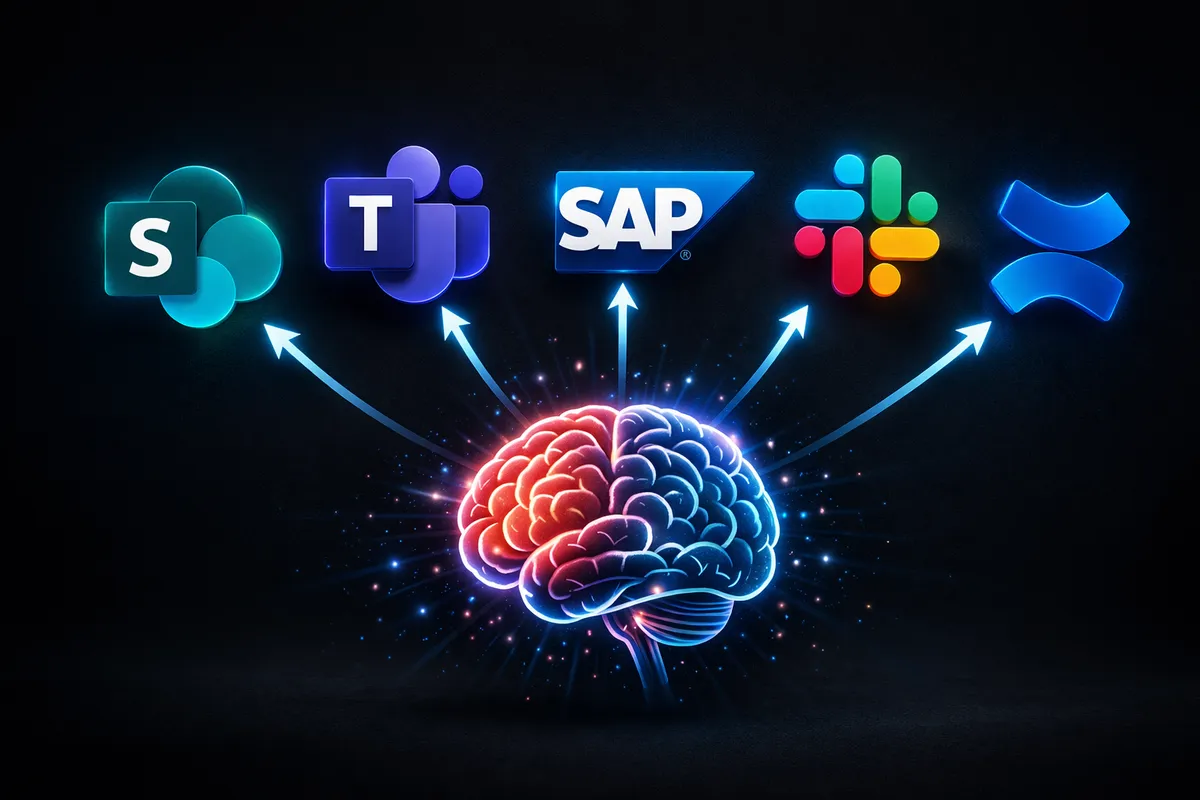
McKinsey estimates knowledge workers spend 19% of their time searching for information (McKinsey Global Institute). At 500 employees, that’s the equivalent of 95 full-time staff doing nothing but searching. The knowledge isn’t missing. It’s trapped in SharePoint, Confluence, Salesforce, network drives, email — and the heads of people about to retire.
AI knowledge management makes that knowledge accessible. Without hiring a knowledge management department to do it.
Why traditional knowledge management fails
Every company over 100 employees has the same five symptoms:
Data silos. Marketing in SharePoint, engineering in Confluence, sales in Salesforce, finance in SAP. Each system an island. A question that spans two of them has no answer.
Headcount. Traditional KM needs people to run it — knowledge managers, editors, taxonomy specialists. In many organizations that’s half a department: curating content, maintaining structures, assigning metadata, retiring stale documents. Companies that can’t justify the headcount don’t do it. AI-powered platforms change the equation: automatic tagging, classification, and duplicate detection replace the manual work. What used to need a team can be a side responsibility.
Stale versions. 83% of employees work with outdated document versions (IDC, 2024). Not carelessness. The current version is unfindable. The draft exists in three places across three drives; nobody knows which one is final.
Knowledge walks out. Senior people leave. Process knowledge, customer history, decision rationale — none of it is captured in a wiki or handover.
Search doesn’t actually search. SharePoint search finds SharePoint. Confluence search finds Confluence. A unified search across all systems doesn’t exist in most organizations.
What AI changes
Four capabilities, in order of impact:
1. Semantic search
Keyword search finds “PTO request” only if the document contains those exact words. Semantic search understands meaning: a query for “how do I request time off?” also finds “Q4 2025 Absence Policy” because the AI recognizes the concept.
Live demo:
2. Automatic classification and tagging
AI reads documents and assigns metadata automatically: topic, department, confidentiality, document type. What takes humans hours, AI does in seconds — across thousands of documents at once. Duplicates and stale versions get flagged.
3. Summarization and extraction
“Summarize the key changes in the new vendor agreement.” “What compliance requirements apply to our product in California?” AI pulls answers out of long documents without anyone reading 50 pages.
4. Automatic distribution — knowledge to where it’s needed
Finding isn’t enough. The real test: what happens when a new safety directive ships? When a product recall hits all locations? When a compliance update needs to reach every employee in 48 hours?
Traditional KM says “we posted it in the wiki.” AI knowledge management says “we formatted it for the right channel and delivered it to the right people — automatically.”
In practice: information is approved once. The platform identifies who needs it (department, location, role), formats it per channel (short for digital signage, long for email, notification for Slack/Teams), and delivers at the right time. Production workers without a PC see it on the break-room screen. Knowledge workers get a Slack ping. Executives get an email digest.
Why this matters for headcount: without automatic distribution, someone manually adapts and sends every message to every channel — for every location, language, audience. That’s a full-time role no mid-size company wants to fund. With automated distribution, the platform handles it. The human approves. The AI distributes.
The options
| Solution | Data sources | Hosting | Strength | Weakness |
|---|---|---|---|---|
| Microsoft Copilot | Microsoft 365 only | Cloud (US) | Deep M365 integration | One ecosystem only |
| Google Gemini | Google Workspace only | Cloud (US) | Strong summarization | Google data only |
| Elastic/OpenSearch | Any (API) | On-premise possible | Flexible, open source | Needs a dev team |
| On-premise AI platforms | 40+ systems | On-premise | Broad connectivity, full data control | Upfront investment (cheaper per seat than cloud above 200 users) |
For companies whose knowledge spans more than one ecosystem — most of them — a cross-platform solution is the only path.
Illustrative scenario: knowledge management at a mid-size manufacturer
Mid-size industrial company, 600 employees across four locations.
Before:
- Technical docs in Confluence (12,000 pages)
- Contracts and POs in Salesforce
- Project files on network drives (200 TB)
- Internal comms in Teams and email
- Average search time per employee: 1.5 hours/day
After (on-premise AI platform):
- All sources searchable through one semantic interface
- Automatic classification on new documents
- Duplicate detection across system boundaries
- Multilingual search, no manual translation
- Automatic distribution of critical updates to digital signage, Slack, email
- Estimated time savings: 45 minutes per employee per day
At 600 employees and $75/hour fully loaded, that’s six-figure annual savings — even if only a third of employees search daily. The on-premise investment pays for itself inside year one.
Unlock your enterprise knowledge — without the cloud contboxx Vault connects to ~40 systems, makes your knowledge base searchable, and distributes critical information automatically. On-premise, fully under your control.
Five steps to AI knowledge management
- Inventory. Where does your knowledge live? Which systems are critical, which are redundant? 1–2 weeks.
- Choose a platform. Three criteria: which sources to connect, how sensitive the data is, how many users. Sensitive data + sizeable user base → on-premise wins on compliance overhead.
- Pilot. One scoped use case (technical docs or contract database). 20–50 test users, 4–6 weeks.
- Feedback and adjustment. Which queries work, which don’t, where are sources missing. This phase decides user adoption.
- Rollout and training. Scale incrementally. People need to understand how it works and where it doesn’t.
What AI knowledge management can’t do
Honest limits:
Tacit knowledge. AI finds what’s documented. The experience of a 20-year engineer who never wrote anything down can’t be surfaced. Solution: knowledge-transfer programs where senior staff document their expertise — AI then makes that documentation searchable.
Data quality. Garbage in, garbage out. If your documents are unstructured, outdated, or contradictory, AI search reflects that. An initial cleanup is worth it.
Permissions. AI shouldn’t show everything to everyone. HR records, salary information, board documents need access restrictions. Good platforms inherit permissions from source systems. The setup needs careful review.
Hallucinations. Language models can generate plausible-but-wrong answers. For critical decisions (legal, financial, compliance) human verification is always required. The best platforms show source references so users can verify.
FAQ
Can AI really search across all enterprise systems?
Yes — via connectors. Modern platforms ship integrations for 20–40+ systems: SharePoint, Confluence, Salesforce, Slack, Teams, network drives, email. Prerequisite: the platform needs network access to the source systems. Permissions inherit from the source.
How long does AI knowledge management take to implement?
Turnkey on-premise: 4–6 weeks to a productive pilot. Self-hosted open source: 3–6 months depending on IT capacity and number of data sources. The slow part is usually the data sources, not the AI.
Is AI knowledge management GDPR-compliant?
Depends on the architecture. Cloud-based solutions transmit data to external providers, which needs DPAs and possibly cross-border safeguards. On-premise AI processes everything locally and removes those obligations.
Bottom line
AI knowledge management isn’t futuristic. It’s the logical answer to a problem every growing company has: knowledge exists, but nobody can find it. And when they do find it, nobody distributes it to the people who need it.
Start with one document corpus and one department. Six weeks tells you whether the approach holds in your specific environment.
AI in the office — 8 applications that save time → | Knowledge loss in the enterprise →