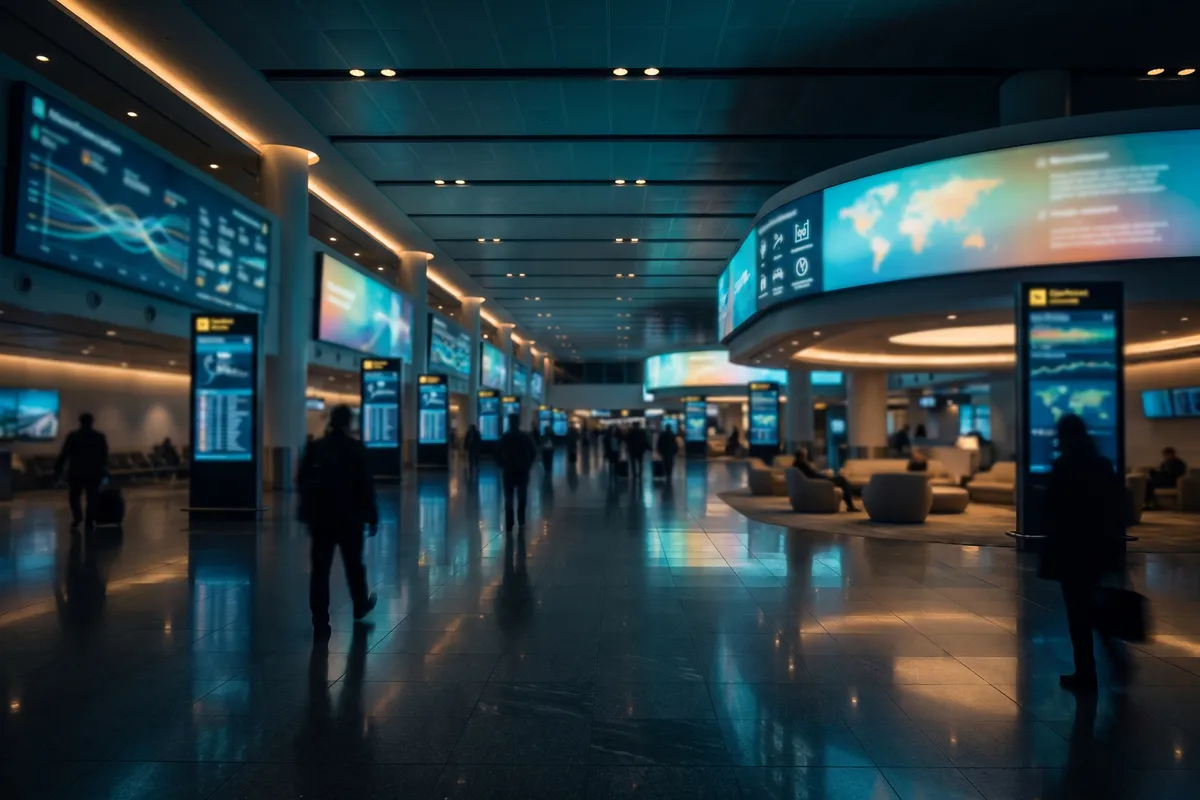
An international airport can see passengers from dozens of countries pass through in a single shift. A traveller from Seoul looking for a connecting gate may speak neither the local language nor English. When the orientation screens only carry the national language plus English, that’s a navigation problem — and in the stressed context of transit, a serious one.
Airport digital signage content in this environment isn’t a communication campaign. It’s infrastructure. And like every other piece of transit infrastructure, it has to work for everyone — multilingual, current, reliable.
What makes transit a hard environment
Transit hubs are the most demanding setting for digital signage because they stack several extreme conditions:
Maximum audience diversity. No other venue type sees a comparably heterogeneous visitor pool inside a single hour. Business travellers, families, tourists, older travellers, non-native speakers — each with different information needs and different baseline knowledge.
Stress and time pressure. Passengers are rushing, often unsettled by delays, often tired. The attention window is narrow. Content has to be graspable in seconds.
Safety-critical adjacency. Departure changes, security instructions, emergency announcements — these have to be current and understood. Multilingual delivery isn’t a comfort feature here, it’s an operational requirement.
24/7 operation. Airports and major stations don’t close. The screen at 03:00 has to work as well as the screen at 12:00.
Why single-language content under-performs
The common solution in many transit hubs: content in English plus the national language. Sounds reasonable. In practice it usually leaves a meaningful share of travellers unaddressed — at a German airport with heavy East-Asian traffic, at a Spanish high-speed station with heavy Northern-European tourism, the people most in need of orientation often find nothing in their first language.
The visible consequence: visitors ignore screens they can’t read. The hardware investment doesn’t earn the engagement it was supposed to.
How Atlas handles 15 languages
The traditional model for multilingual signage: write once in a main language, then commission translation. That’s expensive, slow, and unworkable for daily-fresh content.
Atlas doesn’t translate — it generates in the target language directly. The English text isn’t a translation of the German text; it’s an independently written text for English-speaking travellers, working from the same extracted facts. The result reads more natural and lands more relevant.
Supported languages: English, German, French, Spanish, Portuguese, Italian, Dutch, Polish, Russian, Chinese, Japanese, Korean, Arabic, Hindi, Turkish. Fifteen total, configured per venue. For an airport with mainly European, East-Asian, and Middle-Eastern traffic, five to eight active languages is typical.
First batch of translations into a newly activated language can take up to 24 hours. After that, every new published item appears in the active languages almost immediately.
What works on transit screens, and what doesn’t
Works:
- Local weather (relevant for arrivals and departures alike)
- Short-form current news (under 20 words per item, no disaster coverage)
- Dining and retail orientation inside the terminal
- Local-city highlights for first-impression visitors
- Short practical info (Wi-Fi, charging, services)
- Safety and emergency information in multiple languages
Doesn’t work:
- Long-form text (it won’t be read)
- Complex graphics (not graspable at speed)
- Content irrelevant to the transit scenario
- Stale information (a screen with old data in transit is actively harmful)
Format rules of thumb:
- 15–20 words max per slide in transit zones
- High contrast, large type
- Clear visual separation between informational and commercial content
Real-time operations vs. editorial layer
A clean distinction matters: departure/arrival, gate changes, and delay notifications are operational data from the operator’s flight or rail information systems. They are not content-engine output.
Atlas runs alongside the operational stream and supplements it with editorial context — news, weather, local recommendations. The two layers stay separate by design: the operational feed handles the functional core, the content engine handles the surrounding zones. When the operational stream is quiet, the editorial layer keeps the screens worth looking at.
Legal posture in public transit
Publicly operated transit hubs — airports with state ownership, national rail stations — typically face stricter accessibility and multilingual requirements. In several jurisdictions, information screens in public transport are subject to minimum language standards.
On top of that, the usual copyright and licensing rules apply to anything displayed. AI-generated content with verified legal distance is the cleanest answer in this context too. The full framing: Legal distance and AI-generated content.
What operators get out of automation
For airport and station operators, automated multilingual content delivers concrete operational shifts:
Lower information-desk load. Fewer queries about events, dining, and services — the screens already answer them.
Consistent quality, no shift gaps. 24/7 with the same baseline. Nights, weekends, holidays — the screen keeps showing current, relevant content.
Scale without proportional effort. Five screens or five hundred — the engine generates for all of them in parallel.
Multilingual without staffing. No multilingual editorial team to keep ten languages current.
For the broader pattern of AI in operational environments: AI in the office.
Illustrative scenario: regional airport with high international share
How a regional airport automated the editorial layer of its screen content
Illustrative, not a customer reference.
Baseline: 25 screens in the terminal — 18 for operational flight data, 7 for editorial content (dining, weather, local tips). Editorial was handled as a side task by two marketing staff. Quality and freshness drifted.
With Atlas: a transit venue profile focused on weather, regional dining, arrival tips, and cultural highlights. Four active languages: German, English, Spanish (Mediterranean routes), Turkish. Editorial content refreshes on its own; operational data continues to flow through the existing flight information system on a separate feed.
Effect: consistent freshness on the editorial layer, clean separation from operational data, marketing time freed up for campaigns rather than slide maintenance.
Screens that keep themselves fresh contboxx delivers licensed news and AI-generated content to your displays, fully formatted — multilingual, automatic, no editorial effort.
Frequently asked questions
How many languages can Atlas generate for transit screens?
Fifteen, configured per venue: English, German, French, Spanish, Portuguese, Italian, Dutch, Polish, Russian, Chinese, Japanese, Korean, Arabic, Hindi, Turkish. The active language profile is set once and adjusted when the passenger mix shifts — the first batch in a newly activated language can take up to 24 hours, after that translations track new publications in near real time.
Can Atlas display real-time departure information?
No. Atlas is a content engine for the editorial layer, not for operational live data. Departures, arrivals, gate changes, and delay notifications come from the transit operator’s information systems. Atlas runs alongside those feeds and supplies supplementary content (news, local tips, dining notes) for the screen zones where a live operations feed isn’t needed.
How does Atlas keep content appropriate for the transit context?
The transit venue profile fixes text length (short, optimised for 5–10 seconds of read time), topic mix (news, weather, dining, local tips, connection information), and exclusions (no long-form, no divisive topics, no disaster reports). The profile can be tightened to the specific posture of a given airport or station rather than serving generic content into a specific environment.
What does integration into an existing transit screen system look like?
Atlas delivers content through four standard formats — REST API, RSS 2.0, JSON Feed, HTML Widget — so any digital signage CMS or player that consumes those formats can take the feed without player-specific work. The integration drops a feed URL into the player the same way an external content stream would be configured.
Is AI-generated content appropriate for safety-critical communications?
No. Safety-critical information — evacuation instructions, emergency alerts, platform changes, security announcements — must come from verified operational systems, not a content engine. Atlas is explicitly the editorial, non-critical layer, and is intentionally distinct from operational information pipelines, which have different availability and verification requirements.