“We’ll handle it in-house” sounds like a cost saving. In practice it’s usually more expensive than an external solution — because the hidden costs stay invisible during budgeting: staff time, error cost, and the opportunity cost of stale content.
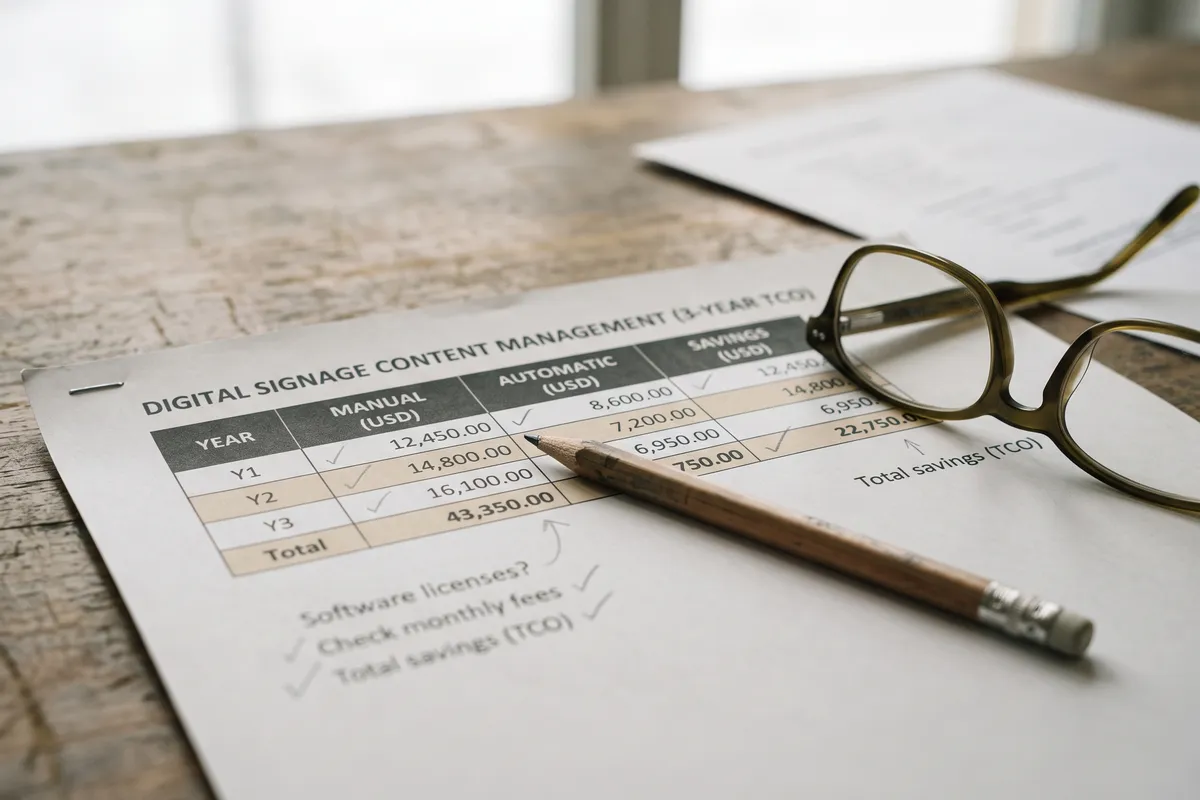
This digital signage content cost comparison makes those costs visible. Three scenarios, same operator profile — 20 screens, three venue types, three-year horizon — and the actual all-in number for each.
Methodology: what goes into TCO
A complete TCO includes:
- Direct costs — licences, subscriptions, integration fees
- Staff costs — hours spent on creation, maintenance, oversight
- Opportunity costs — lost revenue from stale content, missed promotions
- Compliance costs — risk provisioning for copyright or licensing exposure
- Quality costs — customer-experience impact of poor or outdated content
Not all of these can be quantified precisely. Where that’s the case, conservative estimates are used and noted.
Scenario 1 — fully manual content management
Assumptions
- 20 screens, 3 venue types (hotel, retail, corporate)
- Dedicated content manager at ~40% allocation, or shared resource
- Weekly update cycle
- No newswire feed, no AI engine
Direct costs
| Cost type | Year 1 | Year 2 | Year 3 | Total |
|---|---|---|---|---|
| Design software | £250 | £250 | £250 | £750 |
| Image licences (stock photography) | £900 | £900 | £900 | £2,700 |
| Occasional external design work | £1,200 | £600 | £600 | £2,400 |
| Total direct | £2,350 | £1,750 | £1,750 | £5,850 |
Staff costs
| Task | Hours/week | Hours/year | Cost/year (£60/h) |
|---|---|---|---|
| Content creation and research | 3.5 h | 182 h | £10,920 |
| Layout and formatting | 1.5 h | 78 h | £4,680 |
| Deployment and oversight | 1.0 h | 52 h | £3,120 |
| Total | 6.0 h | 312 h | £18,720/year |
Staff cost over 3 years: £56,160.
Opportunity and quality costs
Stale content (typical age ~8 weeks): reduced relevance, estimated revenue impact in retail ~5%, hotel upsell ~8%. Conservative estimate: £4,000 per year in lost revenue. Compliance: image-licensing and unlicensed-text exposure, risk provision £800 per year.
TCO scenario 1 (3 years)
| Category | Amount |
|---|---|
| Direct | £5,850 |
| Staff | £56,160 |
| Opportunity | £12,000 |
| Compliance risk | £2,400 |
| Total TCO | £76,410 |
Scenario 2 — newswire feed + manual supplements
Assumptions
- Newswire licence for 20 screens
- Manual supplements for venue-specific content (reduced effort)
- Technical integration and ongoing maintenance
Direct costs
| Cost type | Year 1 | Year 2 | Year 3 | Total |
|---|---|---|---|---|
| Newswire licence | £11,000 | £11,000 | £11,000 | £33,000 |
| Technical integration (one-time) | £3,500 | — | — | £3,500 |
| API maintenance | £1,200 | £1,200 | £1,200 | £3,600 |
| Image licences (newswire feeds rarely include images) | £450 | £450 | £450 | £1,350 |
| Design software | £250 | £250 | £250 | £750 |
| Total direct | £16,400 | £12,900 | £12,900 | £42,200 |
Staff costs (reduced with newswire in place)
| Task | Hours/week | Cost/year |
|---|---|---|
| Venue-specific supplements | 2.0 h | £6,240 |
| Oversight and curation | 1.0 h | £3,120 |
| Total | 3.0 h | £9,360/year |
Staff cost over 3 years: £28,080.
Quality costs
Newswire content isn’t venue-adapted: reduced relevance for hotel and retail. Estimate: £2,400/year.
TCO scenario 2 (3 years)
| Category | Amount |
|---|---|
| Direct | £42,200 |
| Staff | £28,080 |
| Quality | £7,200 |
| Total TCO | £77,480 |
Scenario 3 — AI content engine (Atlas)
Assumptions
- Atlas subscription on contboxx.com (tier sized to request volume, not screen count — for 20 screens polling hourly, the Professional tier with 5,000 requests/day is well above the actual draw)
- Fully automated content operation
- Minimal manual input for strategic in-house content
Direct costs
| Cost type | Year 1 | Year 2 | Year 3 | Total |
|---|---|---|---|---|
| Atlas subscription (indicative tier) | £3,600 | £3,600 | £3,600 | £10,800 |
| Self-service onboarding | £0 | — | — | £0 |
| Design tool for in-house content | £250 | £250 | £250 | £750 |
| Total direct | £3,850 | £3,850 | £3,850 | £11,550 |
Staff costs (minimal)
| Task | Hours/week | Cost/year |
|---|---|---|
| Strategic in-house content submissions | 0.5 h | £1,560 |
| Oversight and quality check | 0.5 h | £1,560 |
| Total | 1.0 h | £3,120/year |
Staff cost over 3 years: £9,360.
Quality costs: largely eliminated
Daily fresh, venue-adapted content. Residual quality cost: ~£400 per year.
TCO scenario 3 (3 years)
| Category | Amount |
|---|---|
| Direct | £11,550 |
| Staff | £9,360 |
| Quality | £1,200 |
| Total TCO | £22,110 |
TCO comparison: all three scenarios
| Manual | Newswire | AI Content Engine | |
|---|---|---|---|
| Direct costs (3y) | £5,850 | £42,200 | £11,550 |
| Staff costs (3y) | £56,160 | £28,080 | £9,360 |
| Quality / compliance (3y) | £14,400 | £7,200 | £1,200 |
| Total TCO (3y) | £76,410 | £77,480 | £22,110 |
| TCO per screen per month | £106 | £108 | £31 |
| Venue adaptation | No | No | Yes |
| Multilingual | No | Limited | Yes (15 languages) |
| Daily fresh content | No | Yes | Yes |
Saving AI vs. manual: ~70% over 3 years. Saving AI vs. newswire: ~70% over 3 years.
What these numbers actually mean
Staff cost is the dominant factor in the manual approach — and the line item organisations most systematically under-budget for digital signage. Six hours per week on screen content for an internal salary costs the organisation more than £18,000 per year. That’s opportunity cost for a task most ops plans treat as “background.”
This isn’t an argument against internal communications work. It’s an argument for concentrating that work on the strategically valuable share and automating the repetitive daily layer.
For the wider picture: AI in the office and AI cost comparison.
Quick TCO calculator for your network
3-year TCO: manual workflow vs. AI content engine
Screens that keep themselves fresh contboxx delivers licensed news and AI-generated content to your displays, fully formatted — multilingual, automatic, no editorial effort.
Frequently asked questions
Are these TCO figures applicable to every organisation?
The specific numbers vary by screen count, venue mix, staffing rates, and existing systems. The ratios — AI substantially cheaper than manual and newswire approaches — hold for the large majority of typical operators. Very small networks (under 5 screens) shift the math; larger networks (50+) make the effect more pronounced, because the engine’s marginal cost per screen drops while the manual approach scales linearly.
What if we already have a newswire licence?
At contract renewal, a full TCO comparison is worth running before signing again. For mid-term termination, weigh penalty fees against the annual saving — typically the switch pays off even with 6–12 months remaining. A parallel pilot phase (AI content on test screens) during the remaining term is feasible and gives you a side-by-side reference before the renewal date arrives.
How is Atlas actually priced?
Atlas is priced by subscription tier on contboxx.com: Starter (100 API requests/day), Professional (5,000/day), Enterprise (50,000/day), each with a 60 requests/minute burst. Tier sizing depends on poll frequency and screen count, not on screens directly — for most mid-size networks the Professional tier sits comfortably above actual draw. The specific euro/pound number depends on your tier and the contboxx.com pricing page at sign-up.
Are staff costs actually saved, or do they just move elsewhere?
The reclaimed hours typically flow into strategic work — campaigns, internal comms, projects that previously got pushed to “next week.” In honest reporting that’s a reallocation, not a personnel cost reduction. It still beats the alternative: hours absorbed by routine screen maintenance that the organisation never asked the strategic team to handle in the first place.
What happens if Atlas goes down — do the screens go dark?
Atlas delivers content into the screen CMS. On a connection failure, the screen system shows either cached content (last successfully fetched cycle) or a pre-configured fallback slide. There’s no hard screen outage tied to the content engine. The Atlas pipeline itself runs on standard cloud infrastructure with the typical availability profile for SaaS — and is decoupled from the player by design.