A 15-minute extension to a wait time pushes perceived waiting time up by as much as 40% when patients sit in a stimulus-poor environment. The same real wait feels meaningfully shorter when patients are engaged or feel informed. That’s a measurable effect — and exactly the lever clinical screen content can pull, if the content is right.
Hospital digital-signage screens aren’t decoration. They can reduce anxiety, carry compliance information, lift patient satisfaction scores, and reduce the burden on staff who otherwise field “how much longer?” 20 times per shift. But only if the content is right.
What patients actually need in a waiting room
Patients in a clinical waiting room are in a specific emotional state: they have information needs (what happens next? how long?), they have concerns (diagnostic uncertainty, fear of pain, the unknown), and they have time that feels long without engagement.
Effective screen content for this context has to:
- Inform — transparency about processes and wait times measurably reduces stress
- Distract — positive, easily consumable content shortens perceived wait
- Calm — tone and imagery match the emotional state of patients
- Educate — prevention and treatment information that prepares the visit
What to explicitly avoid:
- News content with negative tone (disasters, crime, health crises)
- High-frequency image transitions or aggressive colour palettes (raise agitation)
- Commercial advertising that treats patients as consumers
- Information overload — too many messages at once
Content categories for clinical screens
1. Process and queue information
“Your doctor will see you in approximately 20 minutes” is the most valuable sentence on a clinical screen. When patients know what comes next, tension drops immediately. Hospital management systems can feed this real-time data as an integrated stream alongside the editorial content.
2. Health and prevention information
Healthcare facilities are the best context for health education — patients are attentive and receptive. But content has to be medically accurate, legally sound, and appropriate to the department’s specialty.
Suitable:
- General prevention measures (movement, nutrition, sleep)
- Seasonal health tips (flu vaccination, sun protection, heart health month)
- Educational content matching department specialty (cardiology: heart health; orthopaedics: back prevention)
Not suitable:
- Diagnostic guidance or self-medication recommendations
- Content requiring specialist medical knowledge to interpret
- Health claims without scientific basis
3. Calming nature visuals
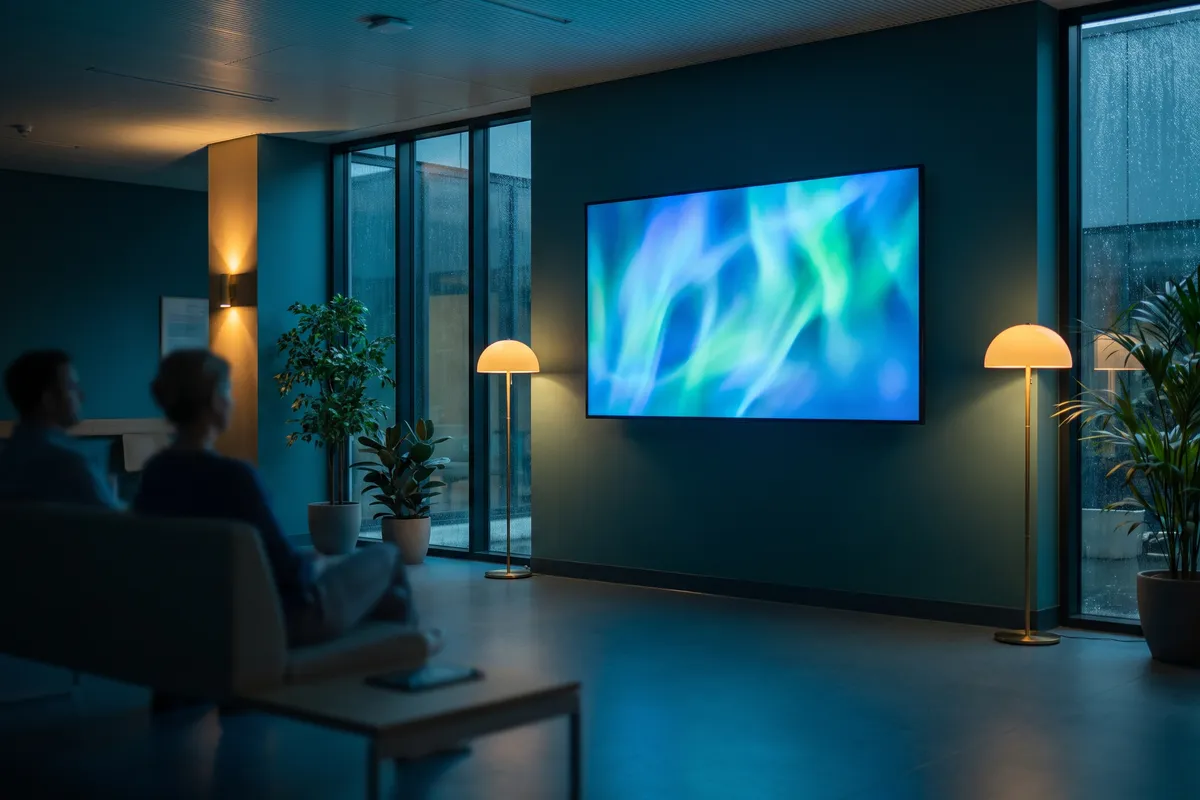
Environmental psychology research consistently shows: nature imagery — forests, water, open landscapes — measurably reduces cortisol levels and perceived stress. A screen that alternates between information text and calming nature visuals improves the overall patient experience in ways that show up in satisfaction scores.
4. Facility information and wayfinding
For many patients, a hospital is unfamiliar territory. Screens can help:
- Directions to departments, A&E, pharmacy, cafeteria
- Team introductions (faces and short descriptions build trust)
- Service information (Wi-Fi access, visiting hours, parking)
5. Positive and uplifting content
Short inspiring messages, local community stories, information about ongoing facility projects (renovations, new departments, awards) — this builds connection and trust without causing agitation.
Copyright and liability in healthcare content
Healthcare environments have specific requirements for content quality and legal safety:
Medical communications law. In many jurisdictions, health-related claims in public communications are regulated. Displaying health statements on clinic screens that aren’t scientifically substantiated can expose the facility to compliance risk.
Copyright. Images, texts, and videos displayed without licensing can generate damages claims — even when the operator is “only” displaying an RSS feed. The legally clean alternative: AI-generated content that doesn’t reproduce copyrighted source text. Legal distance and AI-generated content.
Data protection. Screens in clinical settings must not display patient data — no names, no room numbers, no treatment information on surfaces visible to other patients.
How automated content relieves clinical staff
Hospitals and clinics rarely have dedicated editorial teams for screen content. Screen maintenance falls to whoever has a moment — usually a nurse or admin staff member who is already stretched thin and shouldn’t be doing it in the first place.
Automated content solves this structurally:
- Daily fresh, venue-adapted content without manual input
- Exclusion profiles automatically prevent unsuitable content (disaster news, commercial advertising) from reaching the screen
- Time scheduling shows quieter content during rest periods
- Compliance presets prevent legally problematic health claims at the source
Atlas ships a preconfigured “Healthcare” channel profile tuned to these requirements. The facility doesn’t need to develop its own editorial ruleset — it activates a profile that already encodes them.
For broader context: AI in the office.
Waiting rooms vs. corridors vs. reception: different contexts
Even within a single facility, screen requirements differ by location:
Waiting rooms (highest requirement). Maximum calming effect, moderate information density, wait-time transparency as priority.
Corridors (low dwell time). Short, rapidly readable information; wayfinding assistance; positive short-form content.
Reception and registration (first encounter). Welcome and orientation; queue transparency; service information (Wi-Fi, cafeteria, pharmacy).
Pre-surgical waiting areas (highest emotional sensitivity). Exclusively calming content. No news, no stimulating content. Nature visuals and brief relaxation prompts.
Illustrative scenario: mid-sized hospital group with three sites
How a hospital network unified waiting-room screens across three locations
Illustrative, not a customer reference.
Before: three sites with different screen systems. Content was maintained locally — clear quality differences and occasional problematic content (political news in waiting rooms, ad blocks without compliance review).
With Atlas: a central healthcare venue profile with strict exclusion rules (no politics, no commercial pharma advertising, no disaster coverage). Site-specific adjustments — pediatrics site gets child-appropriate content, geriatrics site gets calmer topics. The audit log records every output for internal compliance.
Effect: uniform quality, documented compliance, significantly fewer internal debates about “what’s appropriate on the screens.”
Screens that keep themselves fresh contboxx delivers licensed news and AI-generated content to your displays, fully formatted — multilingual, automatic, no editorial effort.
Frequently asked questions
What content is legally problematic on hospital screens?
Health claims without scientific basis, unlicensed images and text, commercial advertising for prescription medicines, and any content that displays patient data in areas visible to others. Unsupported therapy or healing promises are also critical and should be consistently excluded — both for liability and for the ethical posture the facility wants to project.
How does an automated system prevent unsuitable news from appearing on clinical screens?
Through exclusion profiles and topic whitelists. The system recognises the Healthcare venue profile and automatically filters content that doesn’t match — disaster coverage, crime news, divisive politics, content with explicit disease references — at the profile level, before it ever reaches the screen.
Can I integrate real-time queue information into clinical screens?
Yes, when the hospital management system provides a data feed. Atlas runs alongside that feed and incorporates it into the content mix — for example as a persistent corner banner or alternating blocks with editorial content. Live operational data comes from the hospital system; Atlas delivers the surrounding editorial context.
Does signage in clinical settings actually reduce perceived wait time?
Environmental psychology and healthcare research consistently show engagement and information reduce perceived wait time by 20–40%. Screens are an effective tool when the content is right. What matters isn’t the mere presence of moving images, but relevant, easily understood content without stress-inducing topics.
What if a patient finds certain screen content distressing?
A manual override or time-lock that prioritises calming content during sensitive periods is the right answer. Clinical facilities can adjust the content mix at any time — gentler topics in the evening, age-appropriate content in pediatric areas. Profile configuration is not static and doesn’t require a restart to change.