
AI isn’t optional anymore. More than half of European mid-market companies already use it in at least one business area. The hard part now is the deployment shape — cloud or on-premise, broad or narrow — and the compliance cost each shape brings with it.
Most go cloud-first. Microsoft Copilot, Google Gemini, OpenAI Enterprise. Fast to set up, easy to use. The cost shows up later: your data leaves your organization, the US CLOUD Act creates reachability for US authorities, and the works council was never asked. The Frankfurt data center is a reassuring detail. It doesn’t change the law.
What sovereign AI actually means
Sovereign AI is full control over data, models, and infrastructure. Nothing leaves your network. No cloud-vendor dependency. No DPA negotiations for the AI itself.
Data sovereignty is now near the top of every European CIO’s priority list for 2026. Not performance. Not feature count. Sovereignty.
Why now, specifically
Three forces converged in 2026 to push sovereign AI from “nice idea” to “default move”:
1. EU AI Act enforcement. Fines up to EUR 35 million or 7% of revenue. The Act wants demonstrable control over your AI systems — model choice, training, audit trail. With cloud AI, that control belongs to the vendor, not you.
2. Shadow AI is everywhere. The majority of AI usage in companies is uncontrolled — employees bring tools they like, feed them company data, never tell IT. It’s a security risk and a labor-law problem at once (works council co-determination under § 87 BetrVG). Full picture in shadow AI in the enterprise.
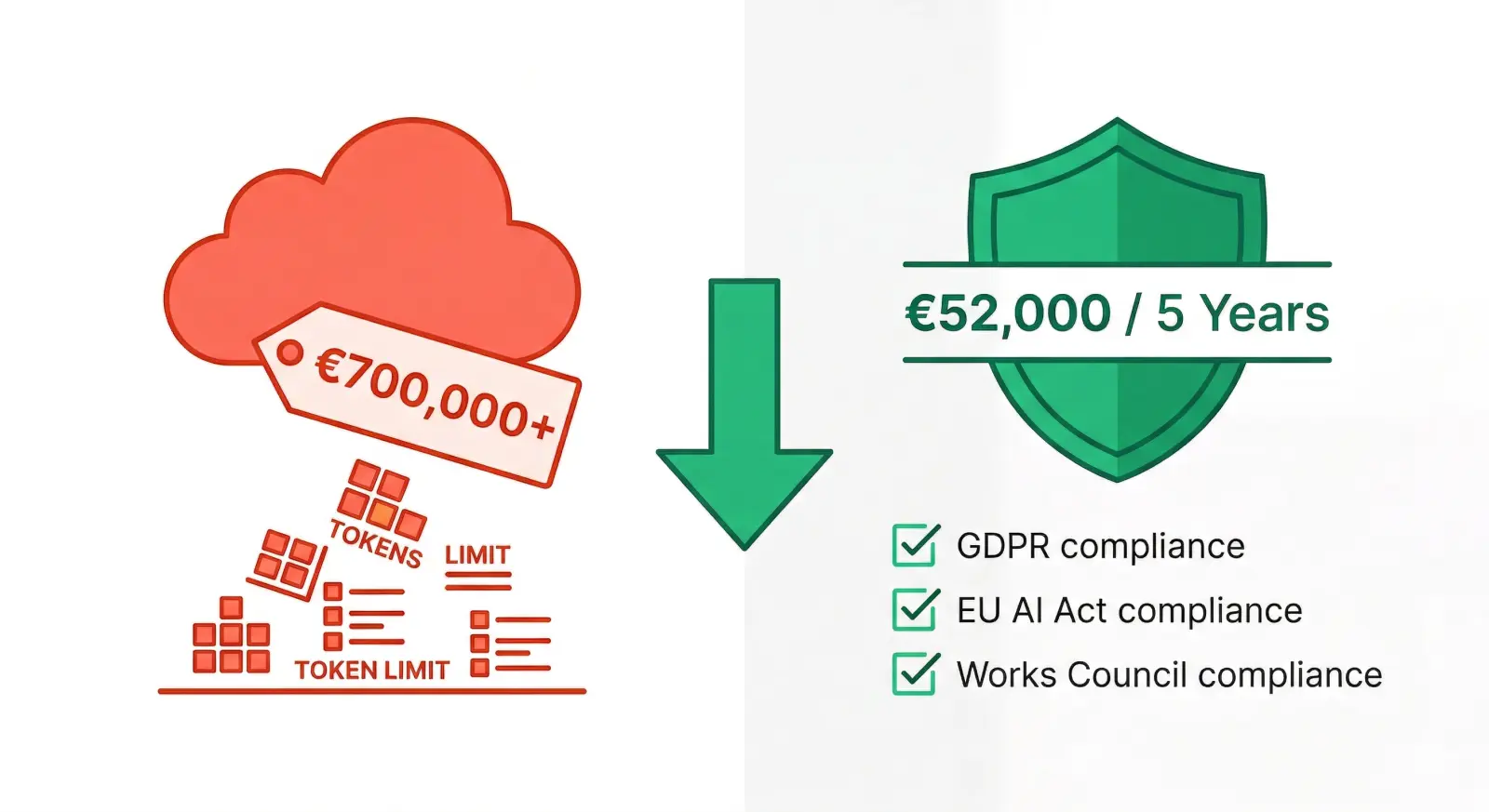
3. Cloud AI costs scale linearly and badly. Microsoft Copilot at EUR 30 per user per month, 500 users, five years: over EUR 840,000 — before implementation, support, or training. Token limits and API costs land on top. Sovereign AI’s economics flatten the curve.
How sovereign AI works in practice
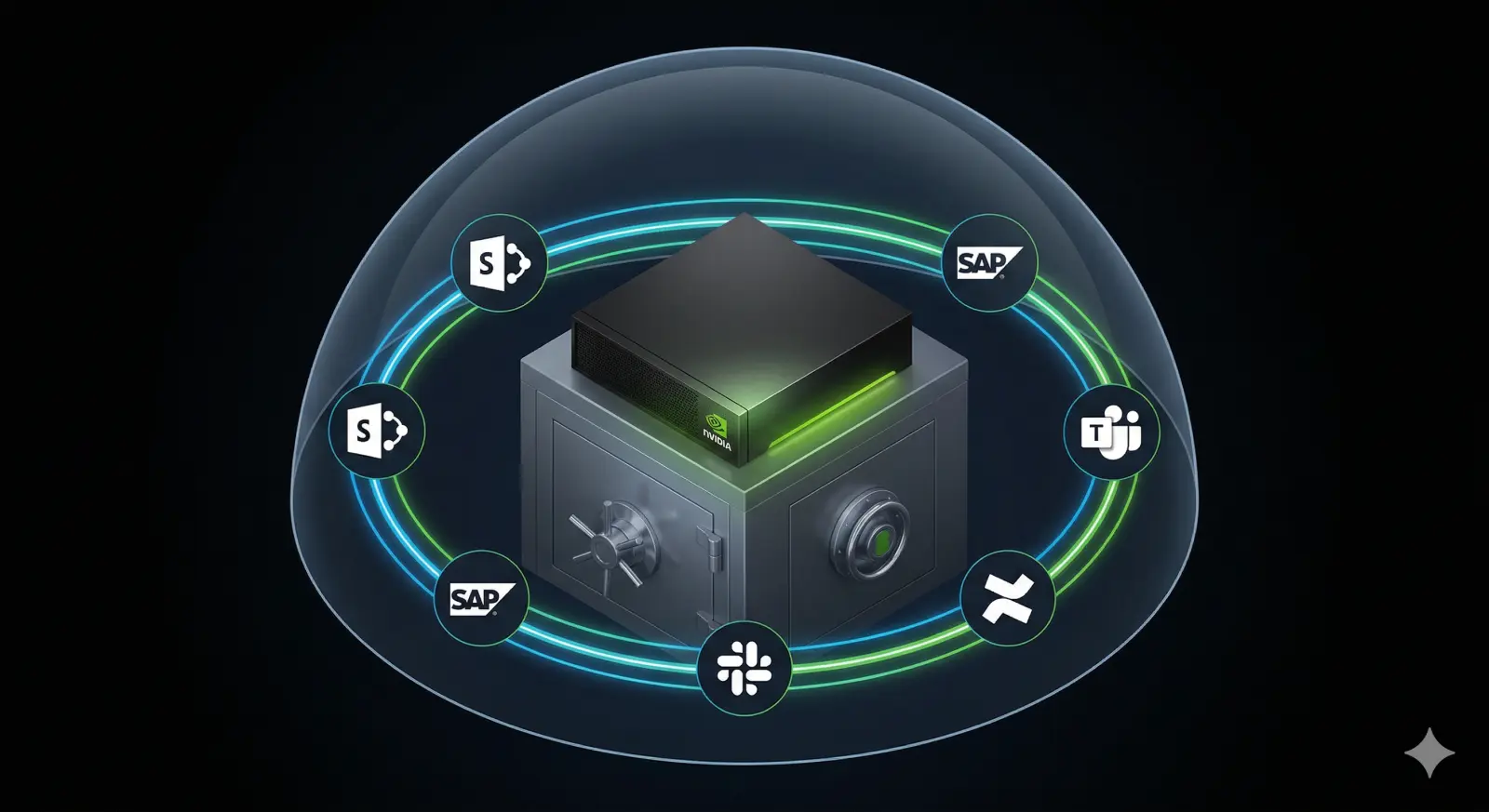
contboxx Vault ships as a turnkey appliance — NVIDIA hardware, pre-installed AI models, ~40 integrations. Live in six weeks.
The workflow:
Step 1 — Connect. Vault plugs into SharePoint, Confluence, SAP, Slack, Teams, and ~40 more systems.
Step 2 — Process. The AI tags, classifies, translates (119+ languages), summarizes, runs compliance checks.
Step 3 — Distribute. Output goes to digital signage, Slack/Teams, email, newsletters — automatically.
Everything runs on your own infrastructure. No cloud vendor sees your data because no cloud vendor touches it.
What it changes in numbers
- Up to 96% cheaper than cloud AI search at scale
- No per-user license. No token caps.
- Five-year TCO from ~EUR 52,000 — versus the EUR 840K+ cloud math above
- ~1,700 hours saved per year on manual document maintenance
- ~EUR 150,000 saved per year on translation
- ~90% less effort on internal newsletter production
These numbers come from operational deployments. They scale with usage, not against it — which is the opposite of cloud AI’s pricing curve.
Bottom line
Sovereign AI isn’t a luxury anymore. It’s the default option for any AI strategy that has to satisfy the EU AI Act, GDPR, and the works council in the same quarter. And it doesn’t have to be expensive or hard.
See contboxx Vault in fifteen minutes Sovereign AI, turnkey, live in six weeks.