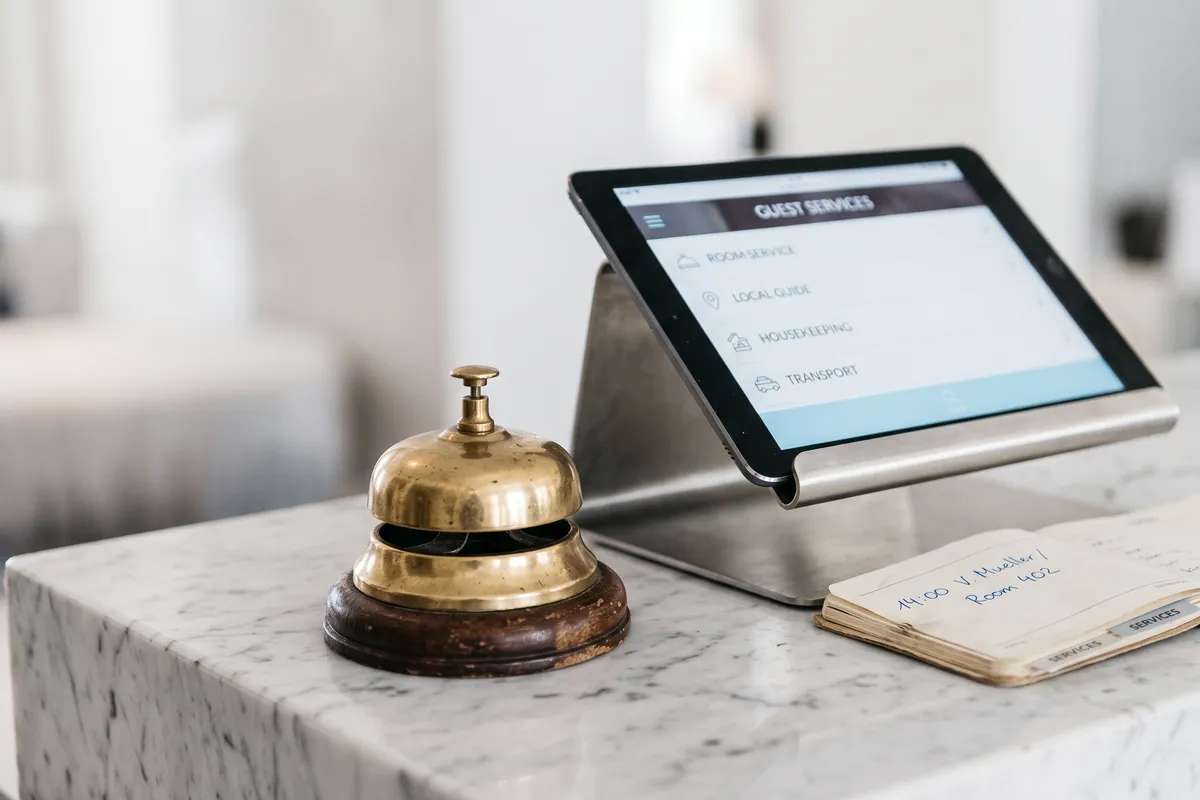
In a study of abandoned digital signage pilots, the most-cited reason for abandonment wasn’t hardware failure or software bugs — it was irrelevant content. The screens were running. Visitors weren’t watching. The culprit: a generic content mix applied across entirely different environments.
Venue-specific content isn’t an optional enhancement. It’s the foundation of any screen network that actually performs. This piece breaks down what venue-specificity means in practice, why it matters differently for each location type, and how an AI content engine handles the complexity without expanding the team.
Three dimensions of venue-specificity
“Different content for different places” sounds obvious. In practice, venue-specificity goes deeper than swapping images.
Attention window. A supermarket shopper spends 8–12 seconds in front of a screen. A hotel guest waiting to check in might stand in the lobby for 4–7 minutes. That changes everything: format, content depth, pacing, and the number of messages the screen can deliver.
Emotional context. A patient in a waiting room is anxious. A hotel guest who just arrived is curious and open to suggestions. A commuter at a transit hub is focused and time-pressured. Content that ignores the emotional context creates friction instead of resonance.
Operator objective. A restaurant wants upsell. A clinic wants to reduce perceived wait time. A retailer wants to drive impulse purchases. A corporate campus wants to align employees with strategy. A generic news feed serves none of these objectives.
Six venue types: what works and what doesn’t
Hotels and hospitality
Context. Lobbies, restaurants, elevators, conference corridors. Guests are in “explore mode” — curious, time-rich, expecting a premium experience.
Works:
- Local weather and event highlights (tailored to guest demographic, not just location)
- Dining and spa recommendations with current availability
- Destination tips and cultural highlights
- Multilingual welcome messages for international properties
- Travel inspiration matching the property’s positioning
Hurts:
- Hard news (crime, disasters, politics)
- Content that clashes with the property’s positioning
- Anything that feels templated
Revenue link: Industry benchmarks consistently show that well-curated hotel screens increase average F&B spend by 12–18% — because guests act on visible, contextual recommendations.
Clinics and healthcare
Context. Waiting rooms, reception, corridors. Patients are anxious and information-hungry. Content has to calm, inform, and constructively fill wait time.
Works:
- Health and prevention tips (tailored to department or specialty)
- Calming nature imagery and positive visuals
- Transparent queue and process information
- Explainers on treatments, aftercare, and what to expect
- Clinic information: team, departments, wayfinding
Hurts:
- News about pandemics, medical scandals, health crises
- High-frequency visual transitions (raises anxiety)
- Commercial content that treats patients as consumers
Critical requirement. Healthcare content has to be medically accurate and liability-safe. AI-generated health claims without source anchoring are a risk, not a solution.
Retail
Context. Point-of-sale, checkout zones, entrance areas. Short attention windows, high purchase motivation, intense competition for eyeballs.
Works:
- Product highlights and seasonal promotions
- Social proof (ratings, bestsellers, “most popular this week”)
- Cross-sell prompts (“Pairs well with…”)
- Regional events and in-store activations
- QR codes for instant discounts or loyalty offers
Hurts:
- Text-heavy content (won’t be read)
- Too many competing messages per screen
- Promotions that are no longer running
Cadence. Retail requires the fastest update cycle of any venue type — ideally daily, weekly at minimum. Outdated promotions actively damage credibility.
Corporate and workplace
Context. Reception, corridors, cafeterias, meeting-room displays. Both employees and visitors interact with these screens.
Internal-facing works:
- Company KPIs and project milestones
- HR updates: anniversaries, welcomes, events
- Internal job openings and training opportunities
- ESG and sustainability progress
- Emergency and safety notifications
External-facing (reception) works:
- Brand values and company identity
- Product and solution highlights
- Filtered industry news relevant to the business
- Wayfinding and room scheduling
The challenge. Corporate content ages fast. A quarterly KPI slide from last quarter signals neglect more clearly than a blank screen would.
Transport and transit
Context. Train stations, airports, bus terminals. Maximum stress, minimum time, international audiences.
Works:
- Real-time departure and arrival data (operational feeds, not the editorial layer)
- Local weather and traffic conditions
- Food and retail options within the terminal
- Multilingual emergency and safety information
- Short news snippets (under 20 words per item)
Hurts:
- Long-form reading content
- Single-language displays in international hubs
- Content with no practical value to the traveller
Restaurants and food service
Context. Waiting areas, table displays, bar screens. Guests are relaxed, curious, in discovery mode.
Works:
- Daily and weekly specials updated automatically
- Story behind the dish (origin, ingredients, chef’s picks)
- Wine and pairing recommendations matching the menu
- Seasonal updates and upcoming events
- Local city news and cultural context
Why manual venue adaptation doesn’t scale
An operator managing three venue types — hotel, clinic, retail — would need to:
- Maintain three separate content calendars
- Apply different editorial guidelines per venue
- Check daily whether content is outdated or contextually inappropriate
- Resolve licensing for every image and news item used
With a small team, that’s not realistic. In practice, it collapses into a generic news feed that fits no venue well — and the screens stop earning their place.
An AI content engine solves this structurally. It understands the venue profile, selects sources and topics accordingly, and generates original content — automatically, every day, for every location.
How Atlas implements venue logic
Atlas operates with predefined venue profiles that govern the content mix:
Source selection. From 266 RSS sources, the engine selects only those relevant to the venue type. A hospital screen receives health content, wellness tips, and local events — not financial news.
Tone and length. Text length adjusts automatically. Transit screens get 15-word snippets. Hotel lobbies receive ~80-word texts with more depth. Retail gets punchy headlines.
Language matching. In international hotels or transit hubs, the engine recognises the venue’s language profile and delivers content in up to 15 languages — no manual translation work required.
Anti-hallucination. All generated content is source-anchored at Stage 7 and passes through the deterministic n-gram check at Stage 8 plus the independent quality reviewer at Stage 10. For healthcare venues, those gates aren’t optional.
For more on AI in operational environments without IT overhead: AI in the office.
Five questions before implementation
Before choosing a digital signage solution, answer these:
- Who stands in front of the screen? (Age, language, emotional state, dwell time)
- What should the visitor do, think, or feel after the interaction?
- How frequently must content be updated to stay relevant?
- Who is responsible for content internally — and how much time do they realistically have?
- Are there legal requirements for this venue type? (Healthcare communication laws, pricing regulations, accessibility requirements)
The answers define the technical and organisational frame — not the other way around.
Recommended content mix by venue
| Venue | News | Weather / Local | Promo | Health / Wellness | Company Info |
|---|---|---|---|---|---|
| Hotel | 20% | 30% | 30% | 10% | 10% |
| Clinic | 5% | 15% | 0% | 60% | 20% |
| Retail | 0% | 10% | 60% | 0% | 30% |
| Corporate | 15% | 5% | 5% | 5% | 70% |
| Transport | 30% | 30% | 20% | 0% | 20% |
| Restaurant | 10% | 20% | 40% | 10% | 20% |
These are starting-point benchmarks. The optimal mix depends on the specific venue, time of day, and audience composition.
Compliance and privacy across venue types
Venue-specific content isn’t only a marketing question — it’s a compliance question. Healthcare venues must not incorporate patient data into content, and medical claims must be verifiable. A content engine that works without processing personal data and anchors every output to sources has a structural advantage over systems that build user profiles. For the privacy frame: GDPR-compliant AI.
Scaling from one venue to one hundred
For multi-site operators, venue-specific control is the key scaling factor. A unified platform that automatically generates the right content mix for each location enables growth without linear increases in headcount.
That’s the difference between a content system and a content tool. A tool has to be operated manually. A system runs and adapts.
Which Atlas setup fits your case?
1. Where will the screens primarily be deployed?
2. How many locations are managed together?
3. How many languages do you need?
Screens that keep themselves fresh contboxx delivers licensed news and AI-generated content to your displays, fully formatted — multilingual, automatic, no editorial effort.
Frequently asked questions
What is venue-specific digital signage content?
Content tailored to the location type, the audience, and the emotional context of visitors. A hotel lobby screen shows different content than a clinic waiting room, even if both run on the same platform. What sparks appetite in a restaurant feels inappropriate in a waiting room; what’s professional in a corporate atrium is too dry for retail. The venue profile codifies those differences.
Can AI automatically determine what content suits a specific venue?
Yes. Modern AI content engines like Atlas work with predefined venue profiles that govern source selection, topics, tone, text length, and exclusions. The operator sets the profile once; the engine handles daily selection and generation from there. The point isn’t “true context recognition” — it’s a well-defined profile that encodes the context explicitly.
How often should venue-specific content be updated?
Depends on venue type. Retail and transit require daily updates (often multiple times per day), clinics and corporate environments can work with weekly cycles, hotels typically refresh daily. The key requirement: no outdated or contextually inappropriate content remains visible — a screen showing three-week-old notices does more damage than no screen at all.
What does venue-specific content management cost without automation?
Practitioners managing three venue types typically spend 8–12 hours per week on manual content work — research, preparation, translation, scheduling. With full automation, that drops to under one hour for oversight and occasional adjustments. That’s not just a cost factor; it’s also a question of where the team’s capacity gets allocated.
Are there legal differences in content requirements across venue types?
Yes, significant ones. Healthcare venues face strict medical communication and patient-data privacy requirements. Retail screens must comply with price-display regulations. Transit hubs have international accessibility and multilingual obligations. A source-anchored, rule-governed content engine with venue-specific exclusion rules substantially reduces these compliance risks compared to manually managed mixed approaches.