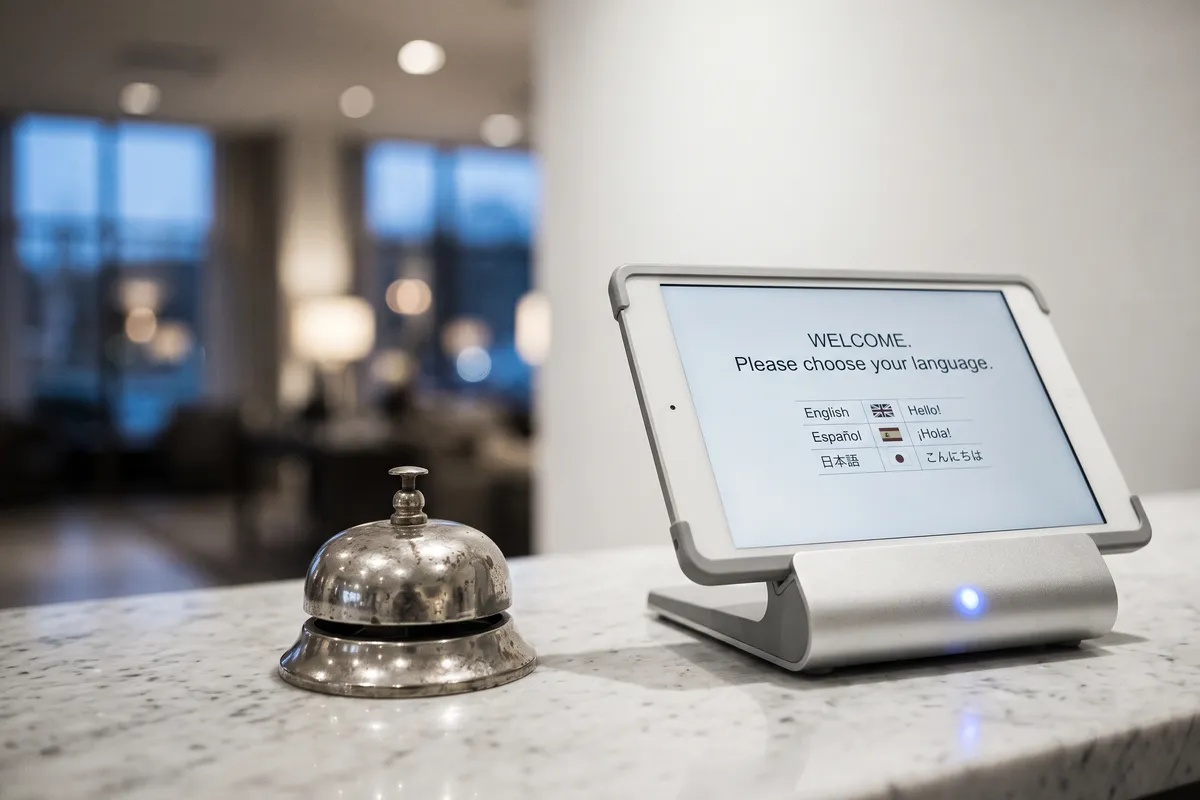
A luxury hotel in Frankfurt. 60% of guests come from abroad — from the US, Japan, the Netherlands, France, and Arabic-speaking countries. The lobby screen runs news and hotel information: in German.
The content is current. The layout is professional. For the majority of guests it’s simply not readable — or at least not without effort. Multilingual digital signage for internationally oriented hotels isn’t a nice-to-have. It’s the precondition for screen content being noticed at all.
The language problem at international hotels
International guests aren’t the exception in major cities. In Frankfurt, Munich, Hamburg, or Berlin, depending on season and location, 40–70% of hotel guests come from abroad. In resort hotels at tourism hotspots, the share is higher still.
What that means for screen content: a guest who doesn’t read German will notice the screen — and ignore it. Not from lack of interest, but because the content isn’t accessible. Hardware, software, and content production all earn back less than they could.
That’s not a minor issue. Screens in hotel lobbies, restaurants, and conference areas are communication tools — for offers, services, events, local recommendations. If they only reach a fraction of guests, their ROI is dramatically worse than it should be.
Why multilingualism used to be expensive
Multilingual content used to mean:
- Translation: professional translators, proofreading, approval
- Adapted layout: some languages (Arabic, Japanese) need different layout directions
- Workflow: who translates when, how is the process coordinated
- Updates: every content change needs every language version updated
For a hotel with daily-fresh content across four languages, that’s operationally unmanageable. Most hotels therefore stayed at one or two languages — and accepted that a large share of guests wouldn’t be reached.
How AI changes the structure
An AI content engine doesn’t produce content in one language and translate it afterwards. It generates content directly in each target language, from the start.
That’s a fundamental shift. No after-the-fact translation, no sequential process, no per-language cost overhead.
Atlas produces content in up to 15 languages: English, German, French, Spanish, Portuguese, Italian, Dutch, Polish, Russian, Chinese (Mandarin), Japanese, Korean, Arabic, Hindi, Turkish.
For a city hotel in Frankfurt, the configuration might be: German primary, English secondary, Japanese and Chinese for the Asian guest segment. The screen alternates between language versions or shows multilingual layouts side by side.
More than translation: culturally adapted content
Good multilingual content doesn’t just mean translating the same German text into other languages. What interests a Japanese guest differs from what resonates with an American or a French guest.
Cultural relevance comes from:
News and topic filtering. The engine filters not just by language but by relevance to the audience. For screens with a high Asian guest share, different news sources are prioritised than for a business-travel hotel with European clientele.
Local information in the guest’s language. Restaurant recommendations, event notices, excursion tips — more useful when they arrive in the guest’s first language without requiring effort.
Direct address. “Willkommen.” “Welcome.” “Bienvenue.” The first impression on entering the hotel adapts to the guest group.
Configuration: which languages for which hotel?
Not every hotel needs 15 languages. The right configuration depends on the guest mix.
City hotel with international business travellers. English as the primary foreign language covers a large share. Supplemented by one or two additional languages based on origin statistics.
Resort hotel with Asian tour groups. Japanese, Chinese, or Korean as dedicated languages for this guest segment. These guests particularly appreciate content available directly in their language rather than through translation.
Conference hotel with European professional audiences. English as lingua franca, supplemented by French, Spanish, or other European languages based on event origin.
Configuration is set per venue on contboxx.com and can be adjusted seasonally when the guest mix changes during the year. The first translation batch into a newly activated language can take up to 24 hours; after that, every new published item ships in all active languages in near real time.
How venue-specific content strategies work overall: Venue-specific digital signage content.
Practical example: two scenarios
Hotel A — manual, single-language. 15 screens throughout the property, content in German. Two comms staff update slides weekly. Effort: 8–10 hours. Share of guests reached: ~40% (German-speaking guests).
Hotel B — automated, trilingual. 15 screens, profile configured for German / English / Japanese. Daily-fresh content from 266 sources, local information, event notices. Effort: 1–2 hours per week for strategic inputs. Share of guests reached: 80%+.
For the broader hotel-content picture: Hotel digital signage content.
Illustrative scenario: city hotel with two distinct guest segments
How a Frankfurt city hotel rotates between seasonal language setups
Illustrative, not a customer reference.
Before: 12 screens (lobby, foyer, restaurant, conference). Content: German with occasional English. Summer brings more international tourists; autumn brings more European business travellers.
With Atlas: seasonal language configuration. Spring/summer: German, English, Japanese, Spanish (for tourist guest groups). Autumn/winter: German, English, French, Polish (for business travellers and European conference guests). Per language, native-source content, not translated.
Effect: guest perception in reviews — “finally information I can read” — mentioned noticeably more often. Conference attendees from Poland and France explicitly cite the multilingual signage as a positive in their feedback.
Screens that keep themselves fresh contboxx delivers licensed news and AI-generated content to your displays, fully formatted — multilingual, automatic, no editorial effort.
Frequently asked questions
Which 15 languages does Atlas support exactly?
English, German, French, Spanish, Portuguese, Italian, Dutch, Polish, Russian, Chinese (Simplified), Japanese, Korean, Arabic, Hindi, Turkish. Availability of individual languages may vary by content category, but each is generated natively from sources in that language rather than through machine translation from a single source.
Can I switch languages based on time of day or occasion?
Yes. The venue profile supports time-based configurations. A hotel can prioritise English and German content during the day, then switch to English and French for dinner guests in the evening — without a separate change in the screen CMS each time.
How good is the quality of non-English content?
Content is generated natively in each language — not translated German text. Quality and language flow meet the standard of native-language content because sources for each language are selected separately and the model writes in the target language directly. Translation Stage 15 uses Claude Haiku 4.5, chosen specifically for stronger multilingual output and script handling.
What happens if a guest speaks a language that isn't configured?
The screen falls back to the configured default language — in most cases English as the international base. Adding a new language is a profile change on contboxx.com; the first translation batch can take up to 24 hours, after which the new language ships in near real time.
Can the language share on screen be controlled?
Yes. For multilingual screens, you configure how much rotation time each language receives — for example 50% English, 30% German, 20% Japanese. The share can vary by time of day and weekday through the venue profile.