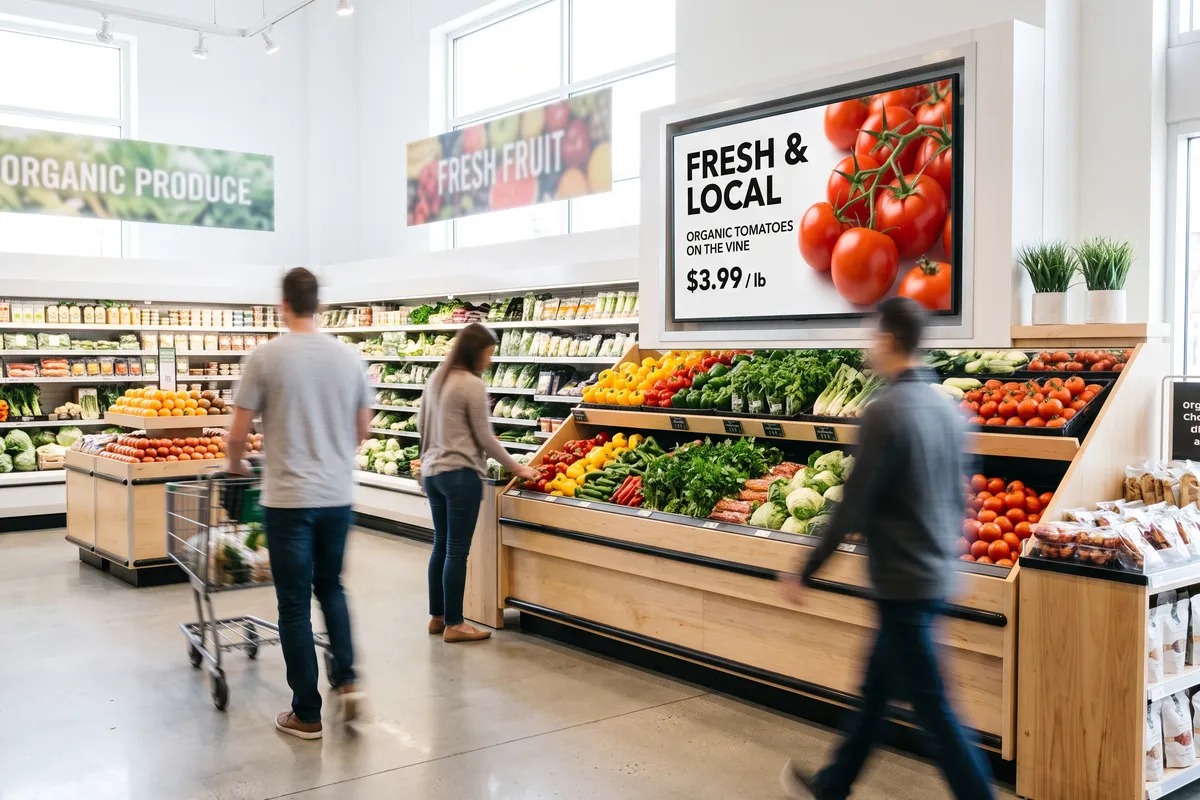
A well-placed retail screen can influence a purchase decision in the final seconds before the shelf. The potential is real — but only if the screen shows the right thing at the right time. Expired promotions, generic imagery, irrelevant news: that’s not a revenue driver, that’s visual noise.
The gap between “screens installed” and “screens earning their place” is mostly a content problem, not a hardware problem. This piece is about how to close it.
The retail-screen paradox: high potential, low realisation
Physical retail has been fighting online competition for years. Digital signage was supposed to help — and in many cases doesn’t, because the implementation misses the potential.
The most common failures:
- Too generic — screens show brand advertising everyone already knows, rather than local relevance
- Too stale — promotions still running after they’ve expired
- Too static — the same content at every hour of the day, every day of the week
- Too little product push — screens next to shelves don’t show product-specific content
- Single language — in tourist areas or urban locations with international customers, multilingual content is absent
Result: customers barely notice the screens — or notice them and don’t feel addressed.
What retail screens can actually deliver
Deployed correctly, retail screens produce measurable results:
Impulse purchases. The most powerful lever in physical retail. Industry research has shown consistently for decades that a substantial share of grocery-purchase decisions are made at the point of sale, not before the trip. A screen that shows the right product at the right moment triggers those impulses.
Cross-selling. “This goes well with…” is one of the most effective sales strategies. A screen next to the wine shelf showing cheese recommendations generates add-on purchases that would otherwise not happen.
Dwell time. Customers who engage with a screen stay in the store longer — and buy more. Industry experience suggests relevant screen content tends to extend average dwell time noticeably, with exact figures depending on store layout and content quality.
Price perception. Professionally presented screens with clear value communication improve price perception — the same price reads as better value when presented with quality content rather than a sticker on a wall.
The AI content strategy for retail screens
An AI content engine for retail operates on several levels simultaneously:
Level 1: seasonal and trend-based content
The engine continuously monitors food, lifestyle, and retail sources and identifies current trends: what’s moving now, which seasonal themes are relevant, what’s catching attention this week. That trend content becomes screen content: “What no summer barbecue should be without” isn’t advertising copy — it’s inspiration, and it sells charcoal, marinades, and drinks.
Level 2: local relevance
Screens in a student-heavy neighbourhood show different content than screens in a suburban shopping centre. The engine differentiates by region, local context, and even weather:
- Rainy weather: comfort food, indoor activities, soup promotions
- Hot weather: cold drinks, sun protection, grilling themes
- Pre-weekend: party food, wine recommendations, snack ideas
Level 3: time-of-day scheduling
The Friday-evening shopper buys differently than the Monday-noon customer. Time-specific content increases relevance:
- Morning: breakfast, convenience, to-go
- Midday: quick lunch solutions, ready meals, lunchboxes
- Evening: dinner ingredients, drinks, desserts
- Weekend: party preparation, brunch ingredients, family formats
Level 4: product-specific placements (manually supplemented)
Automated content forms the background layer. Product-specific promotions — “This week: 20% off all wines” — are submitted manually through the contboxx.com integrations page and displayed with priority. Result: always-relevant background content combined with targeted promotional placements.
Content types by retail zone
Entrance area (first impression)
- Weekly offers and highlights
- Seasonal inspirations
- Loyalty programme reminders
Fresh food and deli counter
- Provenance stories (“Our cheese from the Alps”)
- Preparation tips and recipe ideas
- Seasonal recommendations
Wine department
- Wine recommendations for the occasion / weather / event
- Food-pairing tips
- Winemaker stories
Checkout zone (last opportunity)
- Impulse items with clear pricing
- Quickly consumable snack recommendations
- Loyalty programme reminder
Queue and waiting zone
- Calming content (reduces perceived wait time)
- Service information (opening hours, events, online shop)
- Light entertainment (facts, tips)
Measuring performance: how retail screens are evaluated
Serious retail-screen strategies are measured. The relevant KPIs:
Dwell time. Before/after comparison following deployment (camera-based measurement or comparison with checkout throughput times).
Basket add-ons. Do cross-selling categories increase when corresponding screens are active nearby?
Promotion lift. Sales comparison for advertised products at screens vs. without screen advertising.
NPS and satisfaction. Long-term effect of relevant screens on repeat-purchase rate and customer satisfaction.
Industry experience: well-implemented AI content on retail screens can meaningfully increase sales of promoted products and F&B revenue in combined retail-and-food-service formats. Specific figures vary by location, assortment, and customer base — the honest framing is “measurable lift,” not a single benchmark number that works everywhere.
Multilingual content in retail: an underrated lever
In tourist-heavy locations, city centres, and shopping centres with international customers, multilingual content is a differentiator. An English-speaking tourist who reads a product recommendation in English responds differently than when they receive no information at all.
The engine delivers retail content in 15 languages without translation effort. For the broader venue strategy context: Venue-specific digital signage content.
Legal compliance for retail screens
Retail screens carry the same copyright requirements as other signage applications. The particularly relevant pieces:
Price-display regulations. When prices appear on screens, they must match the checkout price. Outdated prices are a compliance risk, not a UX issue.
Food labelling law. When food products are promoted, certain mandatory disclosures apply.
Image rights. Product photos displayed without licensing can generate copyright claims. AI-generated text eliminates this issue for the text layer. For imagery, own product photography or clearly licensed images are required.
For the legal-distance framework: Legal distance and AI-generated content.
ROI: when does AI content pay off for retail?
For a retailer with 10 screens at one location:
Without an AI content system:
- 3–5 hours/week content management: roughly £8,000–13,000 staff cost/year
- Stale promotions, missed impulse opportunities — hard to quantify, but real
- No scalability for additional locations without proportional cost
With Atlas:
- Under 1 hour/week oversight: roughly £1,500 staff equivalent/year
- Daily current, relevant content: measurably higher promotion effectiveness
- Scalable to additional locations within the same subscription tier (or one tier up)
Break-even typically falls within the first six months of operation for typical retail deployments. The exact number depends on store size, basket math, and how much promotion lift the screens actually capture.
Quick calculation: retail content effort
Screens that keep themselves fresh contboxx delivers licensed news and AI-generated content to your displays, fully formatted — multilingual, automatic, no editorial effort.
Frequently asked questions
Can Atlas automatically push price promotions and weekly specials to screens?
Automatically: only if a POS or ERP integration exists that delivers pricing as a data feed. Alternatively, promotional content can be submitted manually through the contboxx.com integrations page, time-bounded, and displayed with priority — useful for short-notice daily promotions or one-off announcements. The two paths can also be combined.
Which screen placements deliver the highest ROI in retail?
Experience suggests screens at fresh-food counters and wine sections with cross-sell content, and checkout-zone screens with impulse-purchase content, typically deliver the highest measurable ROI. In grocery stores, well-placed screens can lift sales of featured products noticeably — provided the content is genuinely current and relevant rather than stale slides on infinite loop.
How does AI content differ from traditional promotional slideshow software?
Traditional slideshow software shows predefined content that has to be manually created and regularly maintained — slides go stale quickly, and maintenance effort throttles content freshness. AI content is freshly generated daily, dynamically adapted to time of day and season, and kept current without manual maintenance effort. The attention gain from genuinely changing content is substantial.
How does the system prevent irrelevant news from appearing next to product shelves?
The retail venue profile configures which content categories are permitted. For POS screens, typically only food, lifestyle, product, and seasonal topics are approved; general news, political content, disaster coverage, and competing brands are consistently excluded. The whitelist logic is enforced before content reaches the screen, not after.
Do I need separate content profiles for different departments in the store?
Possible and recommended for larger floor areas. Wine section, fresh-food counter, checkout zone, and entrance area can each run with different profiles — different topic priorities, different tonality, different cross-sell logic. All within a single Atlas account, configured on contboxx.com.